

How To Make A Good Drawing Details Engineering
Introduction to Drawing Hands-On Workshop
Pro/ENGINEER Wildfire iii.0

Before you get started
This tutorial is intended to be used alongside Pro/ENGINEER Wildfire three.0 Tryout Edition.
Please make sure that Pro/ENGINEER Wildfire three.0 Tryout Edition is installed on your machine before continuing. Files used or created during this tutorial cannot be used with any other version of Pro/ENGINEER other than the Tryout Edition. Your hosting Hands-on Workshop Application Engineer volition have this ready for y'all. If not, please refer to the READ ME FIRST document.
Download the model files here. Relieve the zip file to your desktop.- Extract the zip file to a location on your hard bulldoze.
A patently bulldoze letter (ex: C:\ ) is recommended. - Launch Pro/ENGINEER Wildfire 3.0
- Gear up your working directory to this location.
For example: C:\HANDS-ON_WF3\DRAWING_TUTORIAL
Your web browser and Pro/ENGINEER can be resized and laid out equally shown below to facilitate your experience.
-
Information is provided at the start of most tasks.
-
Tips are provided along the way.
-
Notes are provided as boosted data.

Positioning Tutorial Window
Information technology is recommended that y'all maximize the amount of working area on your screen by setting your monitor to the highest resolution setting, for example 1600x1200.
Employ the Commands at the top of the page to navigate through the tutorial. Click Next to proceed to the next slide and Previous to return to the previous slide. Click Dwelling to render to the beginning of the tutorial. If the page contains more than information than the visible screen, a scroll bar will appear forth the vertical side. Scroll through the entire contents before progressing to the next pace.
Y'all volition encounter various icons throughout the tutorial:
In that location are several conventions used in this tutorial:
- The "picks and clicks" are shown inBold.
- Text that you enter is shown inBold.
- Icons and their names are shown inline with the text.
- Names of models are shown in CAPS.
- Keyboard keys are shown in CAPS.
Tutorial Summary
In this tutorial, you volition larn the basics of Drawing creation. Both a office and associates drawing volition be created.
Step i: Create a New Part Drawing
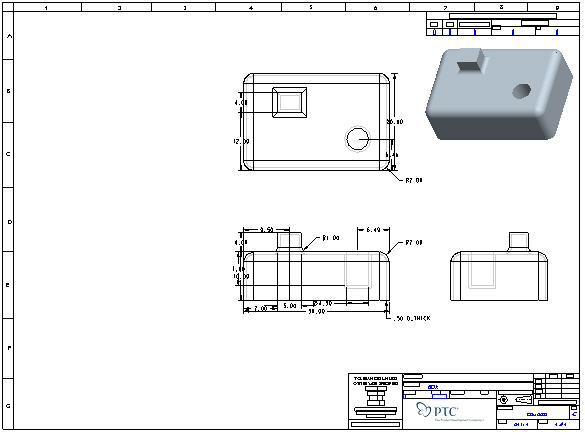
Footstep 2: Create, motility, and dispense cartoon views
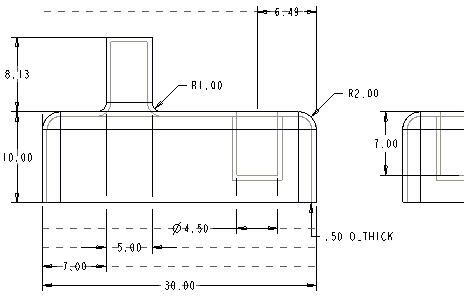
Step three: Create, movement and dispense drawing details such every bit dimensions and notes.
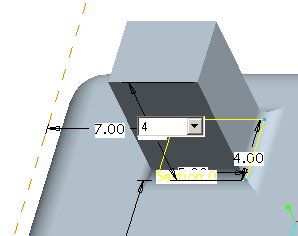
Step 4: Brand pattern changes in the model and in the drawing.
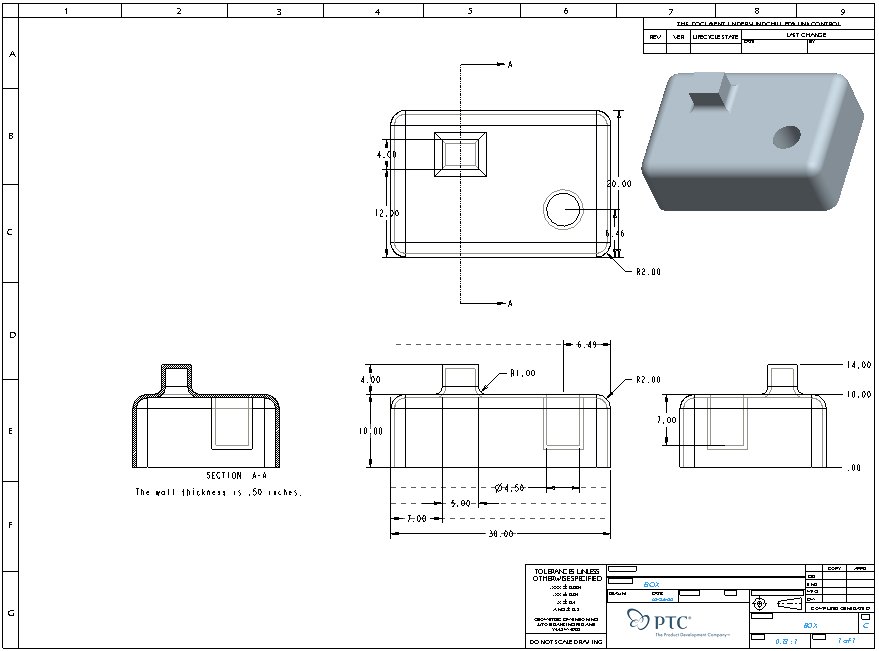
Step 5: Create a New Assembly Drawing
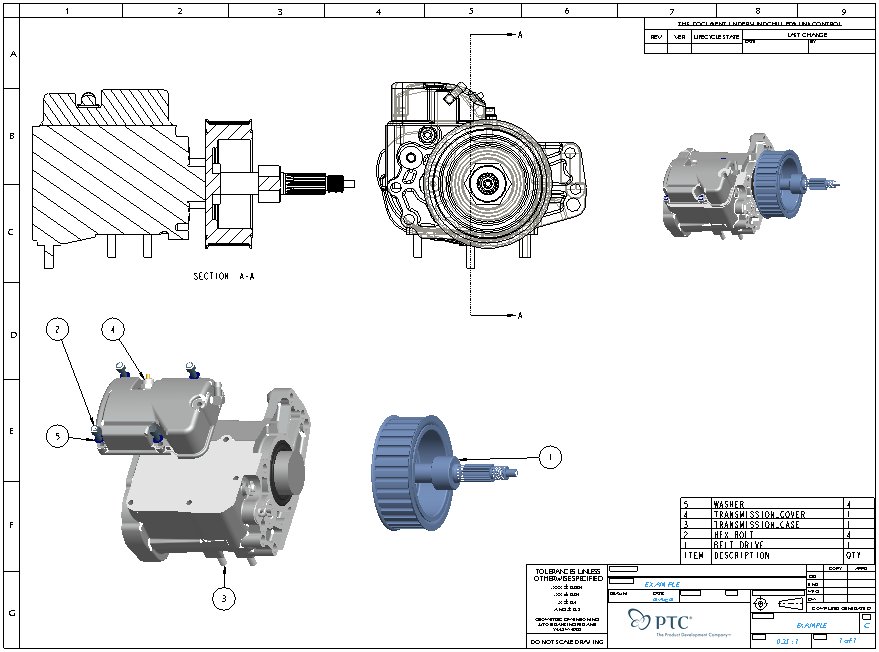
As an alternative to having this open up along-side Pro/Engineer, you can too view a printable version by clicking here.
Task 1. Create a New Function Drawing
-
Get-go Pro/ENGINEER Wildfire 3.0 if necessary.
-
If Pro/ENGINEER is already running ensure all windows are airtight, and all items from the previous exercise are erased from memory.
-
In the Navigator Binder Browser
 , browse to the following folder C:\Easily-ON_WF3\DRAWING_TUTORIAL.
 -
Right-click the DRAWING_TUTORIAL folder and selectReady Working Directory.
-
Click theNew
 icon on the principal toolbar and select Drawingequally the Type in the New Object dialog box.
 -
In the New dialog box, blazon BOX as the Name.
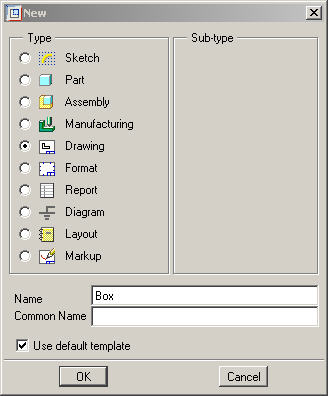

Note that the Utilise Default Template option is enabled.
-
Click OK from the New dialog box.
-
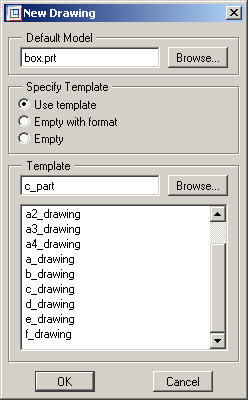
ClickScanfrom the New Cartoon dialog box and select BOX.PRT every bit the Default Model.
-
Click Open.
-
Under Specify Template, select the radio button Apply template.
-
Under the Template section, click Browse and select C_PART.DRW.
-
Click Open.

Drawing templates may be referenced when creating a new drawing. They automatically create the views, set up the desired view display, create snap lines, and testify model dimensions based on the template.
-
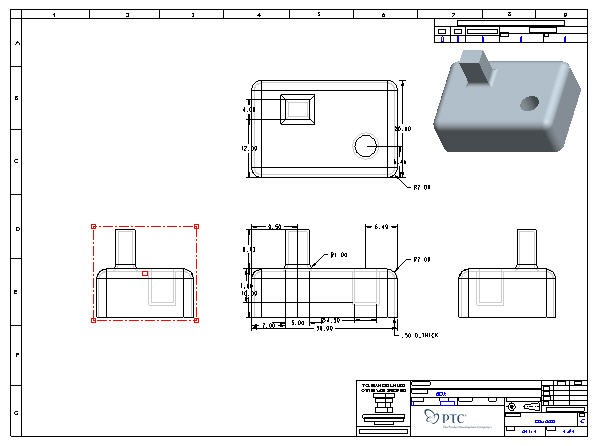
Click OK from the New Drawing dialog box. The template drawing will automatically layout the drawing.

The use of cartoon templates tin can save an enormous amount of time by automatically laying out your standard view with dimensions, cross-sections, notes, etc.
To brand cartoon creation even easier, drawing templates tin can be used to automatically create a new drawing for each new part and assembly y'all create, thus saving you lot the demand to do what y'all only did hither.
-
Click the Datum Planes
 , Datum Points
  , and Coordinate Systems
  icons in Pro/ENGINEER'due south main toolbar.
These buttons toggle datum planes, axes, points and coordinate systems on and off and so that your graphics window doesn't go likewise chaotic.
-
Zoom in
 on the title block in the lower correct corner of the cartoon.
 Accept notation of the intelligence built into the format. Non only has the drawing proper name, scale and date been filled in, just these values are linked back to the source model and volition change if changed in the model -- this insures complete accuracy of the information displayed.
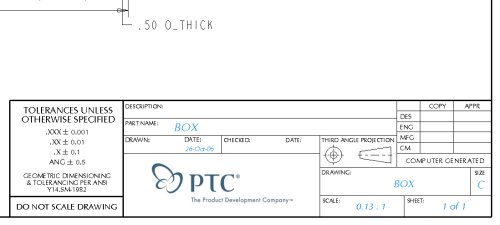
Also note the embedded jpeg logo image. You can use the OLE (Object-Linking Embedding) capabilities for inserting images and other file types into your drawings.
-
 Refit the whole drawing in the window.
Take notation of the shaded isometric view in the upper right corner. Using shaded views in drawings gives more options for communicating disquisitional blueprint information since colors tin provide visual cues to help describe designs. Past using shading, drawings tin can include more detail.
Task 2. Create, motility, and manipulate drawing views
-
Select the Forepart view and then that it is outlined with a dashed red box
-
Press and hold the Correct Mouse Button over the view and uncheck Lock View Motility.
-
With the Forepart view even so selected, Press and Hold the Correct Mouse Button over the view and motility the view around.
-
Release the Right Mouse Button to identify the view
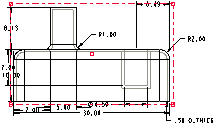
Observe the intelligence of the other views as they volition continue to line up and follow the FRONT view accordingly.
-
Return the FRONT view to its original position by using Edit, Undo from the menus (or use CTRL-Z)
Let add a projected view based off the Forepart view
-
Select the Front end view once more,
-
Press and agree the correct mouse button and select Insert Projection View.
-
Move the mouse around and find that yous have four possible projection options.
-
Select a point to the left of the Front view. The view will expect like to the figure beneath.
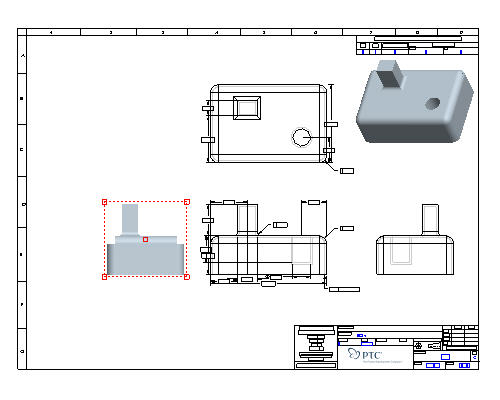
-
With the new view notwithstanding selected, press and concur the right mouse button and select Properties.
To change the properties on more than one view at a time, hold down the CTRL key while selecting them and then access the Properties window from the right mouse push carte du jour. This can include determining visible areas, scaling, defining cross-sections, showing the model in various states, and aligning and setting the view origins.
-
Select the View Display Category in the Cartoon view dialog box , change the Display Style from Follow Environs to Subconscious.
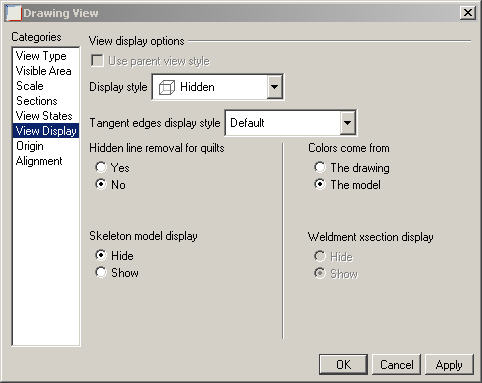
-
Click Apply from the Cartoon View dialog box. The view will appear similar to the effigy below. (Movement the Drawing View dialog box if necessary to meet the changes)
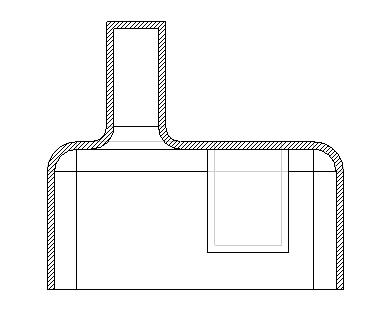
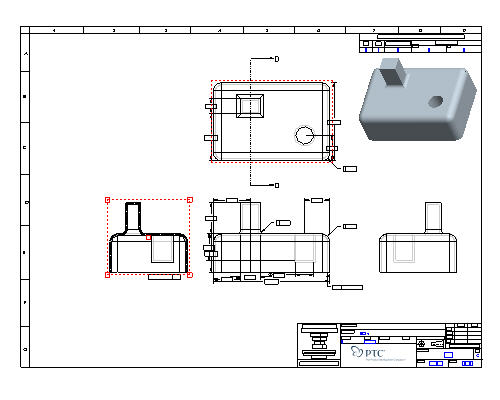
Create a cross-section of the new view nosotros just created
-
Select the Sections category in the Drawing View dialog box.
-
Choose two-D cantankerous section, and click Add Section
 .
. -
Select department A (which is pre-defined in the function) from the Name drop-down.
-
Click Apply.
You can also alter the cross-hatching for certain materials or preferences.
-
Scroll the section definition window all the way to the correct.
-
Click on the empty "Pointer Display" box to activate it.
-
Select the TOP VIEW from the drawing window.

-
Click OK.
Cross-department and view arrows can also exist added by selecting the view and and choosing Insert, Arrows... from the drop-downwardly menus (or past using the right mouse push card to choose Add Arrows)
| | Permit's await at how we can manipulate the views and create additional ones as needed. |
Job 3. Create, move and manipulate drawing details
| | Almost of the work done when creating drawings involves detailing. When yous see the model dimensions on the drawing courtesy of the drawing template, many times y'all will need to movement them around, clean them up and even delete existing or create new dimensions. |
-
Zoom-In
to the FRONT and RIGHT views as shown (Click the Right Mouse Button to abolish the zoom function).
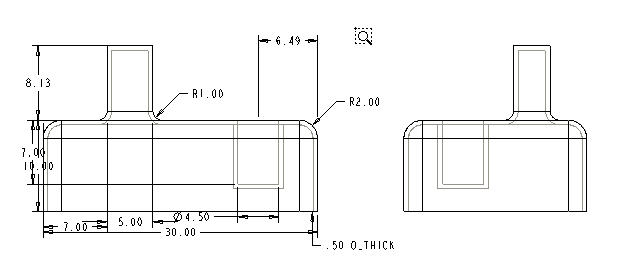
Following any zoom activity, ever click the Correct Mouse Button (or chooseSelect Items
 ) earlier selecting a dimension, view, drawing notation, etc.. . This cancels the zoom function and returns to the option cursor.
 -
Select the vertical vii.00 dimension on the front view (information technology will highlight in red).
-
Hold down the Right Mouse Push button and cull Move Detail to View.
-
Select the RIGHT view to motion the dimension to the Correct view.
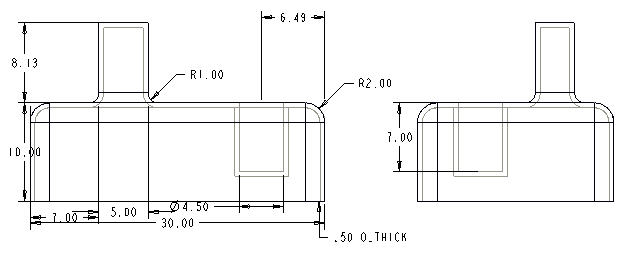
-
Select the vertical height dimension of 10.00.
With a dimension selected, the cursor changes shape to indicate what motion will be performed by holding down the Left Mouse Button and dragging:
 for Upwards, Downwards, Left and Right move;
  for Up and Down movement; and
  for Left and Right movement.
 -
Hold downwardly the Left Mouse Push and drag 10.00 dimension farther away from or towards the geometry.
-
Select and drag the ten.00 dimension up and down (notice the middle snapping).
Center Gravity: Dimensions are automatically centered betwixt the witness lines and when dimensions are moved, they snap to this centered location. This "gravity" location aids in placement.
-
With the 10.00 unit of measurement dimension still highlighted, press and agree the Right Mouse Button and select Flip Arrows from the pull downwardly to change the management of the arrows.
-
Repeat the Flip Arrows command to switch the arrows back.
-
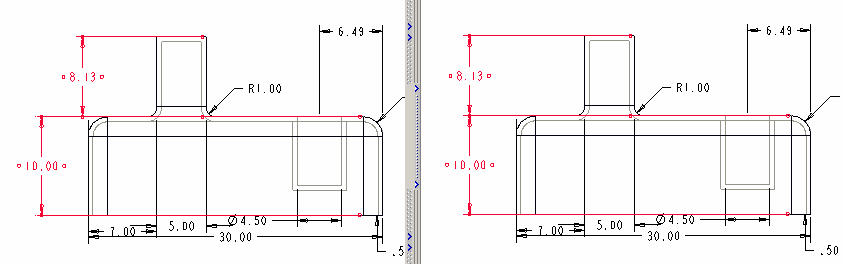
With the 10.00 unit dimension nevertheless highlighted, hold down the CTRL primal and select the 8.13 dimension (the height of the protrusion).
Multi-select items by holding downwards the CTRL key and selecting the items.
-
Press and hold Right Mouse Push and select Align Dimensions from the pull down.
-
Select the Forepart view.
-
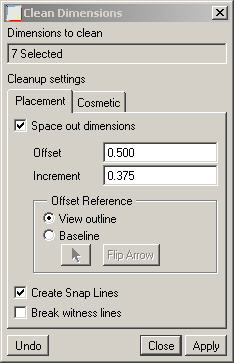
Printing and agree Correct Mouse button and select Cleanup Dimensions from the pull down. A dialog box will pop-up similar to the figure below.
-
Cull the options and type in the values as shown in the figure in a higher place.
-
Clidk Use and Close. Notice how this view tin exist quickly cleaned up.
To use this technique on multiple views, past first multi-selecting the views then doing a Cleanup Dimensions to drastically reduce the amount of manual effort normally involved.
-
Select Info from the pull down bill of fare at the top of the window and cull
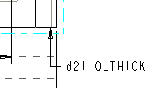
 Switch Dims. This shows the symbol, or "parameter", for the dimensions.
Repeating
Switch Dims will toggle the brandish of dimensions back and forth from numeric to symbolic. Every dimension (and its tolerance values) are represented inside Pro/ENGINNER past these symbols that tin be used in relations or in parametric notes.
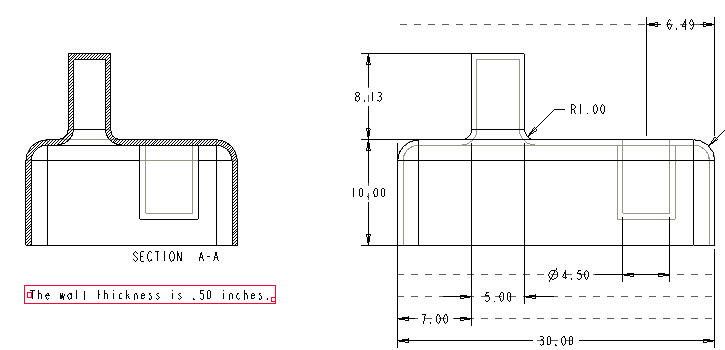
Now let's add a parametric notation that calls-out the wall thickness.
-
Select Insert -> Note... from the drop-down menus.
-
Select Make Note from the menu manager and take all the defaults.
-
Click a spot anywhere nether the Left cantankerous-department view as the desired notation location and middle-click
-
Type THE WALL THICKNESS IS &D21 INCHES and click Accept
 or printing Enter.
This symbolic proper name may be different than shown in a higher place. If then ensure you enter in the correct symbolic proper name in the note creation box.
-
Select Accept
again as you are not creating some other sentence. -
ClickDone/Return from the menu managing director.
You can too add together Ordinate Dimensions that utilise a single witness line with no leader, and are associated with a baseline reference. They are used mostly for flat plate or sheetmetal designs but nosotros volition illustrate an example of this capability on our box role.
-
Insert, Dimension, Ordinate... from the drop-down menus.
-
Select the bottom edge as a baseline from the Right view every bit shown in the figure below.
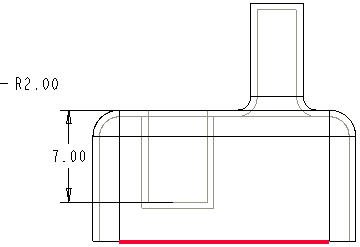
-
Select the two edges every bit shown below to create ordinate dimensions.
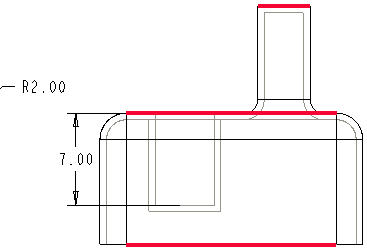
-
Identify the cursor to the right of the view and click the Middle Mouse Button to identify the dimensions.
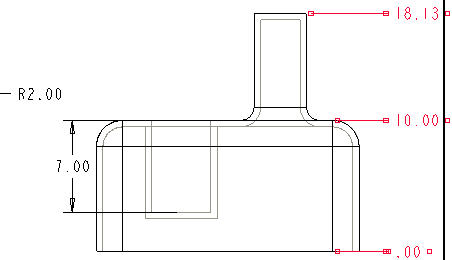
-
ClickReturn from the card director.
You tin can convert linear dimensions to ordinate dimensions and vice-versa. You lot can also take ordinate dimensions automatically created under Insert -> Dimension ->Automobile Ordinate... as opposed to picking the individual entities in our practice. This is extremely invaluable for flat plate and sheetmetal parts.
-
Click Save
 from the main toolbar.
 -
Click OK.
-
Congratulations! Yous take successfully created your first part drawing.
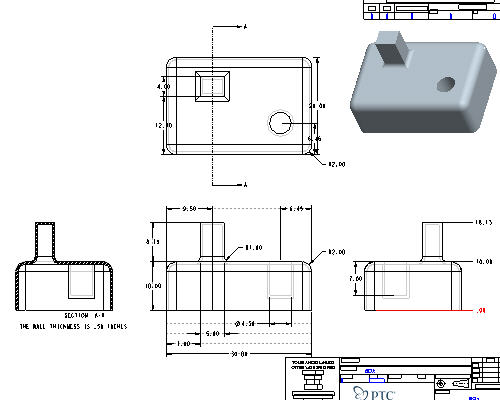
Task 4. Make design changes in the model and drawing
-
Click Open
 from the main toolbar.
 -
Select the BOX.PRTfrom the Open dialog box.
-
Click Open and the BOX.PRT will open in a separate window.
-
From the model tree, Right Mouse Push button select theExtrude ii feature and select Edit.
-
Double-click the viii.13 dimension, change information technology to 4 and press Enter.
-
ClickRegenerate
 the model.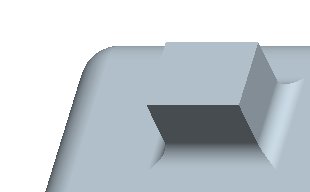
-
Select the pulldown Window, BOX.DRW:1 to switch back to the drawing and run across the changes.
Design changes tin also be fabricated from the cartoon and the model will update.
-
Select the note and press and hold Right Mouse button and selectEdit Value from the pull down.
-
Type0.2 and press Enter
-
Select Regenerate
(again, notice how all the information is accurately updated on the drawing.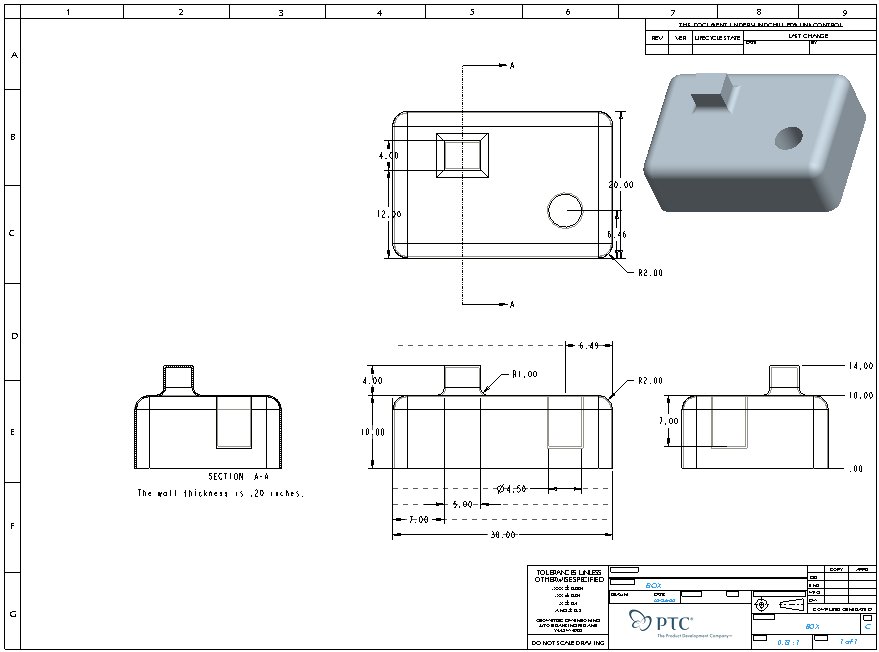
-
Select Window from the pulldown, BOX.PRT
-
Press and hold the Heart Mouse Push button and rotate the office effectually. Notice how the model geometry updated.
-
File, Close Window
 to render to BOX.DRW.
 -
Click Save
from the main toolbar and click OK.Saving a drawing volition also, by default, salvage any modified parts or assemblies it references.
-
File, Close Window
| | Now, let's investigate the outcome of model changes on our drawing. |
| | One of the things that make Pro/ENGINEER the most powerful and respected CAD package on the market today is it'due south model-centric database architecture. In other words, "a single-source-of-truth" where all the concrete properties are kept at the part level and that a change made anywhere gets reflected everywhere. |
Task v. Create a New Assembly Drawing
-
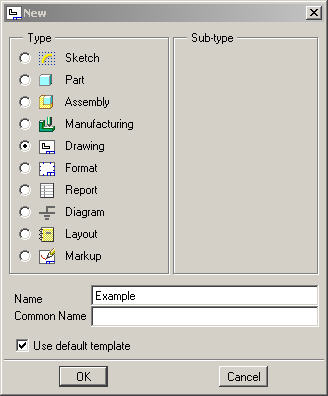
Click theNew
icon on the chief toolbar. -
Select Drawing as the Blazon.
-
Type Example for the Name.
-
Make certain Utilise default template is checked.
-
Click OK from the New dialog box.
-
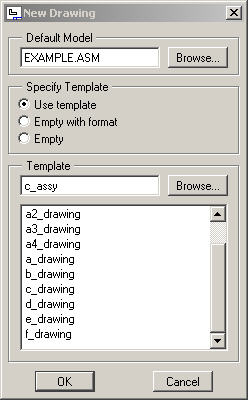
Select Scan... for the Default Model and select EXAMPLE.ASM
-
Select Browse... for the Template and select C_ASSY.DRW
-
Click OK from the New Drawing dialog box. The template cartoon will automatically layout the drawing.
-
If necessary, plow off the brandish ofDatum Planes
, Datum Points , and Coordinate Systems and Repaint 
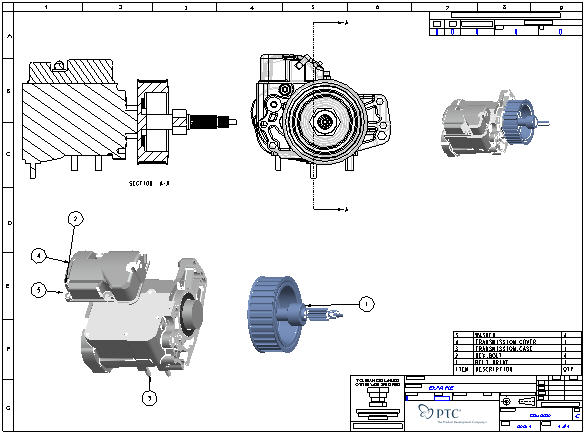
UseRedraw
from the main toolbar anytime to repaint the screen. -
Zoom in
on the lower correct corner to observe the title cake and the Bill of Material tabular array. -
Refit
to see the whole page -
Select a phone call-out airship (as shown below). Notice that the component highlights in the table.
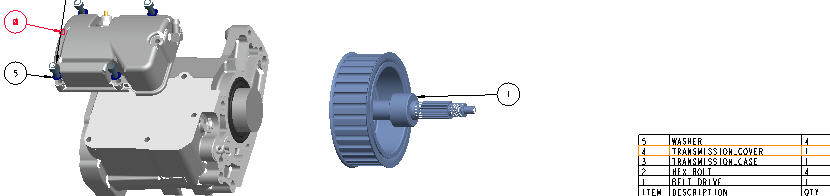
-
Select a different detail in the table. Discover it will highlight the corresponding call-out.
Clean up the telephone call-outs/BOM balloons both manually and automatically.
-
Select the Hex Bolt call-out (#2)
-
Press and hold the Left Mouse Button over the selected phone call-out and elevate it so that its leader line does not cantankerous any other.
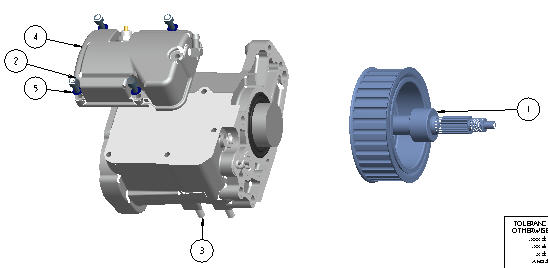
-
Select the exploded view.
-
Press and hold the Right Mouse Button and select Cleanup BOM Balloons.
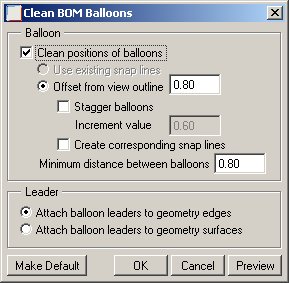
-
Have the defaults and select OK to end.
-
Click Salvage
and click OK. -
Congratulations! You have successfully created your first assembly drawing.

| | Let'southward create a new drawing for the example assembly we created in our "Assembly" tutorial. |

Source: https://support.ptc.com/products/proe/tryout/tutorial4/printable_page.htm
Posted by: schmidtstant1988.blogspot.com
0 Response to "How To Make A Good Drawing Details Engineering"
Post a Comment