

How To Create A Website Using Eclipse
In this exercise you create a servlet which works as a webpage counter. It tracks the number of visitors of the webpage and persists the number in a text file.
4.1. Create web project
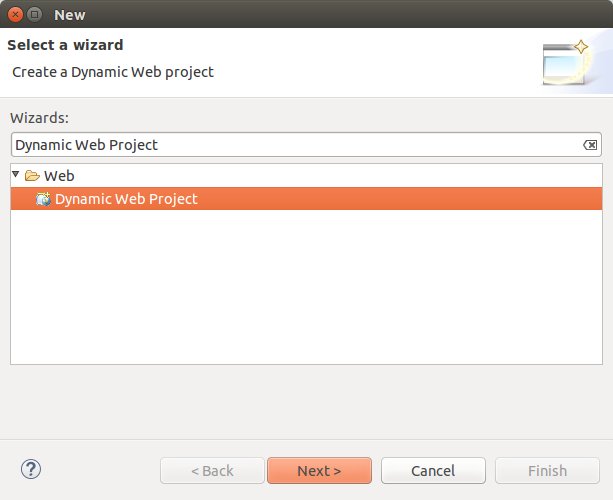
Create a new Dynamic Web Project called com.vogella.web.filecounter by selecting .
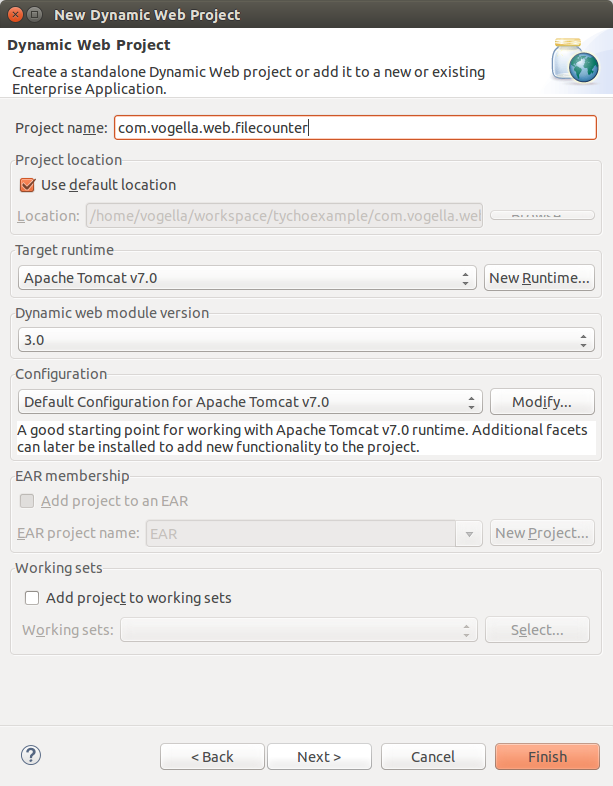
Press twice the Next button and select the Generate web.xml deployment descriptor on the last page.
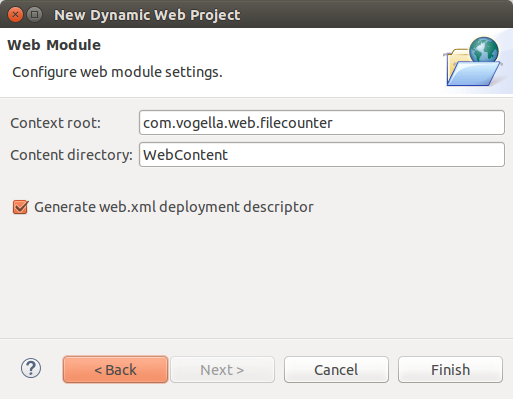
Afterwards press the Finish button.
If Eclipse asks you, to switch to the Java EE Perspective answer yes.
A new project has been created with the standard structure of a Java web application. The WEB-INF/lib directory holds all the JAR files that the Java web application requires.
4.2. Creating Data Access Object
Create a new package called com.vogella.web.filecounter.dao.
Create the following new Java class to read and write the counter value to and from the file.
package com.vogella.web.filecounter.dao ; import java.io.BufferedReader ; import java.io.File ; import java.io.FileReader ; import java.io.FileWriter ; import java.io.IOException ; import java.io.PrintWriter ; public class FileDao { public int getCount () { int count = 0 ; // Load the file with the counter FileReader fileReader = null ; BufferedReader bufferedReader = null ; PrintWriter writer = null ; try { File f = new File ( "FileCounter.initial" ); if (! f . exists ()) { f . createNewFile (); writer = new PrintWriter ( new FileWriter ( f )); writer . println ( 0 ); } if ( writer != null ) { writer . close (); } fileReader = new FileReader ( f ); bufferedReader = new BufferedReader ( fileReader ); String initial = bufferedReader . readLine (); count = Integer . parseInt ( initial ); } catch ( Exception ex ) { if ( writer != null ) { writer . close (); } } if ( bufferedReader != null ) { try { bufferedReader . close (); } catch ( IOException e ) { e . printStackTrace (); } } return count ; } public void save ( int count ) throws Exception { FileWriter fileWriter = null ; PrintWriter printWriter = null ; fileWriter = new FileWriter ( "FileCounter.initial" ); printWriter = new PrintWriter ( fileWriter ); printWriter . println ( count ); // make sure to close the file if ( printWriter != null ) { printWriter . close (); } } } 4.3. Creating the Servlet
Create a servlet. Right-click on your project and select .
Enter the following data.
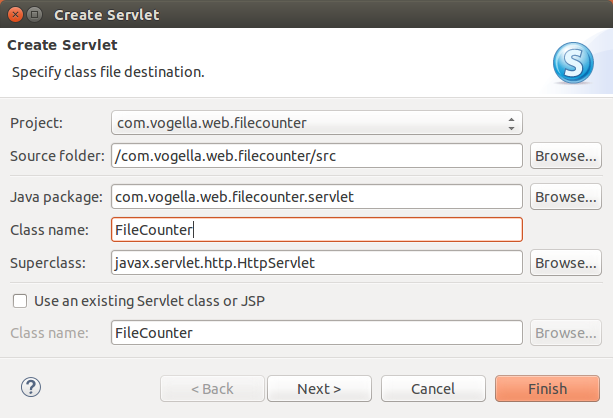
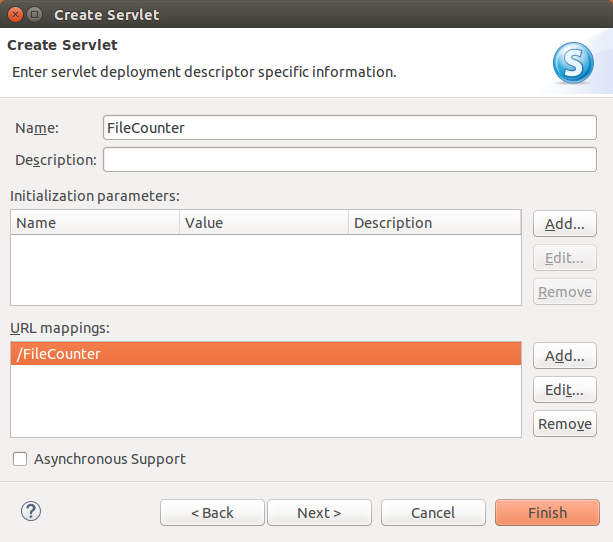
Press finish.
You could also create a servlet without the wizard. The wizard creates a Java class which extends the javax.servlet.http.HttpServlet and adds the servlet settings to the web.xml file.
Enter the following code.
package com.vogella.web.filecounter.servlet ; import java.io.IOException ; import java.io.PrintWriter ; import javax.servlet.ServletException ; import javax.servlet.annotation.WebServlet ; import javax.servlet.http.HttpServlet ; import javax.servlet.http.HttpServletRequest ; import javax.servlet.http.HttpServletResponse ; import javax.servlet.http.HttpSession ; import com.vogella.web.filecounter.dao.FileDao ; /** * Servlet implementation class FileCounter */ @WebServlet ( "/FileCounter" ) public class FileCounter extends HttpServlet { private static final long serialVersionUID = 1L ; int count ; private FileDao dao ; @Override protected void doGet ( HttpServletRequest request , HttpServletResponse response ) throws ServletException , IOException { // Set a cookie for the user, so that the counter does not increate // every time the user press refresh HttpSession session = request . getSession ( true ); // Set the session valid for 5 secs session . setMaxInactiveInterval ( 5 ); response . setContentType ( "text/plain" ); PrintWriter out = response . getWriter (); if ( session . isNew ()) { count ++; } out . println ( "This site has been accessed " + count + " times." ); } @Override public void init () throws ServletException { dao = new FileDao (); try { count = dao . getCount (); } catch ( Exception e ) { getServletContext (). log ( "An exception occurred in FileCounter" , e ); throw new ServletException ( "An exception occurred in FileCounter" + e . getMessage ()); } } public void destroy () { super . destroy (); try { dao . save ( count ); } catch ( Exception e ) { e . printStackTrace (); } } } This code will read the counter from a file on the server and return plain text to the browser. The servlet will increase the counter if the user was inactive for 5 seconds.
4.4. Deployment of the servlet
You application must be deployed to the server and started there. Select your servlet or your project, right-click on it and select from the context menu and select your existing server.
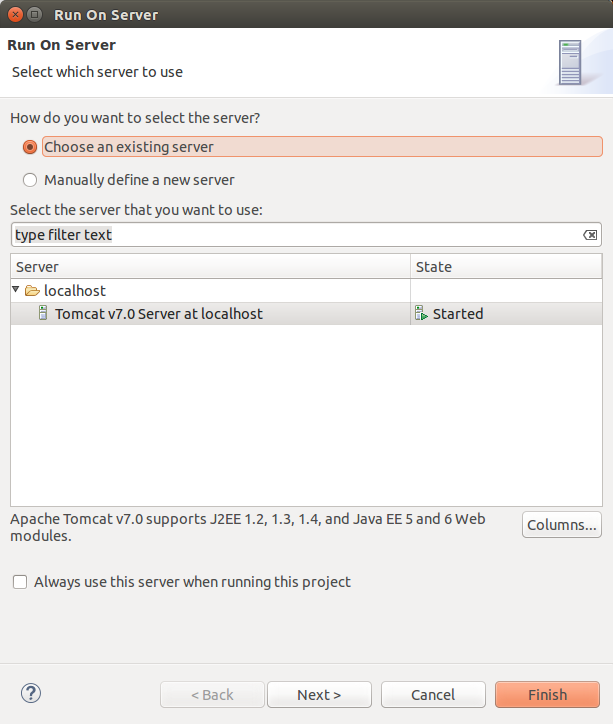
Ensure your servlet is selected to run on the server.
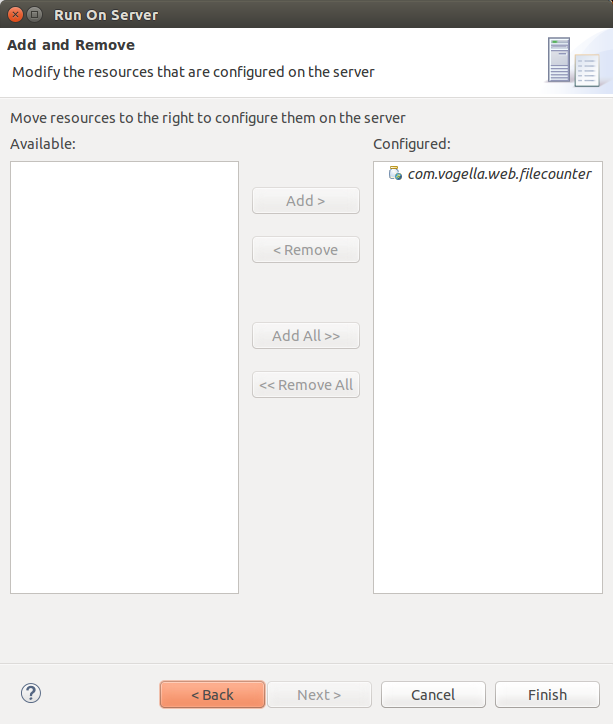
| In case you get the error "The Tomcat server configuration at \Servers\Tomcat v7.0 Server at localhost-config is missing. Check the server for errors.", simply delete the existing server configuration and create a new one. |
Press the Finish button.
4.5. Validate the deployment
If the deployment was successfully you should be able to access your servlet via the following URL:
http://localhost:8080/com.vogella.web.filecounter/FileCounter
The servlet will return the number of times it was accessed. If you wait 5 seconds and refresh the browser, the number should increase.
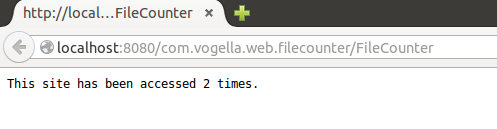
Congratulations. You created your first working servlet with Eclipse WTP!
How To Create A Website Using Eclipse
Source: https://www.vogella.com/tutorials/EclipseWTP/article.html
Posted by: schmidtstant1988.blogspot.com
0 Response to "How To Create A Website Using Eclipse"
Post a Comment