

How Much Current Does A Car Starter Draw

Home, Motorcar Repair Library, Auto Parts, Accessories, Tools, Manuals & Books, Car Web log, Links, Alphabetize

Diagnose Battery, Starter & Charging System
Copyright AA1Car Adapted from an article written by Larry Carley for Import Car magKickoff WITH THE BATTERY
The first affair y'all should ever check when diagnosing a no-start problem is the condition of the battery and land-of-accuse. The battery may exist run downwardly, just a good bombardment will accept and hold a accuse, and deliver the rated number of amps on need. A bad battery won't accept a charge and cannot supply its normal supply of amps because the cells are damaged or worn out.Testing Battery Voltage and Land-of_Charge
Use a voltmeter to cheque battery charge, even if it has a built-in charge indicator. Built-in accuse indicators only read one prison cell, not all six cells. If another cell is bad, you cannot tell by looking at the accuse indicator.A fully charged battery should read over 12.6 volts. A reading of 12.45 volts equals nearly a 75 percent charge and is practiced enough for farther testing. Merely anything less ways the battery is low and needs to be recharged.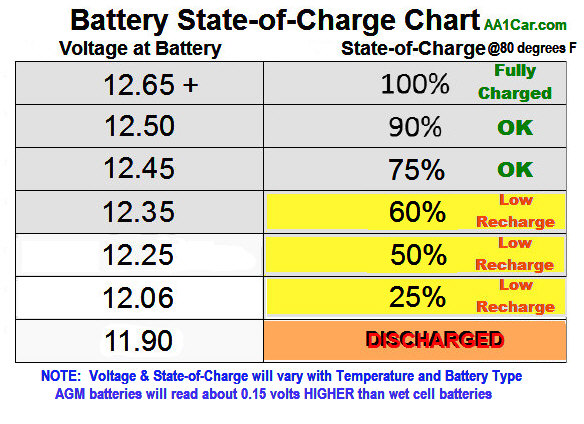
(Annotation: these readings are at 80 degrees F. Battery voltage readings will drop with temperature roughly 0.01 volts for every 10 degrees F.)
(At 30 degrees F. a fully charged bombardment will measure about 12.588 volts, and at nada degrees F it will measure virtually 12.516 volts.)

You can also use a voltmeter to check for voltage driblet across the bombardment cable connections. More than than a 0.4 volt drop would tell you a connection needs to be cleaned.
Regardless of the test method or equipment used to examination a battery, make sure the battery is fully recharged before the client picks upwards his vehicle. The alternator is designed to maintain battery accuse, not to recharge a dead battery. Overloading the charging system with a dead battery tin can tax it to the point that information technology may fry the alternator.CHARGING Arrangement DIAGNOSIS
Ever bank check the performance of the charging arrangement when replacing or recharging a battery. A charging system that is working properly should produce a charging voltage of somewhere around xiv volts at idle (xiii.eight to 14.3 typically) with the lights and accessories off (always refer to the vehicle manufacturer specifications). When the engine is first started, the charging voltage should rise apace to near ii volts higher up base of operations bombardment voltage, then taper off, leveling out at the specified voltage.The exact charging voltage volition vary according to the battery's land of charge, the load on the electric system and temperature. The lower the temperature the higher the charging voltage, and the college the temperature the lower the charging voltage. The normal charging voltage on a typical application might be thirteen.8 to 14.three volts at 77 degrees F. But at -20 degrees F, the charging voltage might be 14.9 to 15.3 volts. For a hot engine on a hot day, the normal charging voltage might drop to 13.5 to 14.0 volts.
Charging output can also be checked with an adjustable carbon pile voltmeter and ammeter. The carbon pile is fastened to the battery and adjusted to obtain maximum output while the engine is running at 2,000 rpm.
Charging amperage is another number that can reveal the condition of the alternator. With the engine idling and no load on the charging arrangement (lights and all accessories off, and battery fully charged), the amperage output should be relatively depression (typically less than 10 amps). With the headlights and heater blower fan on and the engine running at 2,000 rpm, the output should jump to a college reading, typically 25 to 30 amps or more.Annotation: If a vehicle has a history of repeat alternator failures, information technology might mean the battery is not building upwards normal resistance as it accepts a charge. This, in turn, makes the alternator keep charging the battery at a higher than normal rate. The result is that the alternator runs hot, overheats and eventually fails from being over worked. The battery charging current should gradually decrease afterwards the engine starts, and taper off to less than 10 amps at idle (with no lights or accessories on) after five minutes of running. If a fully-charged bombardment is still pulling twenty or more amps after 5 minutes of idling, the battery is defective and needs to exist replaced, Alert: Never disconnect a bombardment cablevision while the engine is running to test the alternator. Doing so can cause high voltage spikes that can harm the alternator as well as other electronics.Some other style to check alternator output is with an oscilloscope. Observing the ripple voltage pattern will tell you at a glance whether or not all the alternator windings are functioning. A skillful pattern should await like the pinnacle of a picket fence. If any of the humps are missing, it means one or more than of the windings is grounded or open, or at that place is a bad diode. Most battery/charging arrangement testers also have a examination function that can detect bad diodes.STARTER Issues
Starter problems can be acquired by worn brushes (carbon pads inside the motor that supply current to the rotating armature), by shorts or opens in the armature or field coils, or by worn bushings that increase drag or allow the armature shaft to rub against the pole shoes.Continuous and prolonged cranking is very hard on a starter motor because it generates excessive heat. If not allowed to absurd down every 30 seconds or and so for at to the lowest degree a couple of minutes, the starter volition be damaged by continuous cranking.You can check out a starter past bench testing it with the proper equipment. Using a battery and a pair of cables to jump the starter will only tell you if information technology spins, non how many amps it is cartoon or how fast information technology is cranking. To accurately test a starter, you have to use a test stand that can measure amp load, voltage and rpm.A expert starter will unremarkably draw 60 to 150 amps with no load on it, and up to 250 amps under load (while cranking the engine). The no-load amp depict volition vary depending on the blazon of starter. If the amp draw is too high, the starter needs to be replaced. The same is truthful if the starter does non accomplish the specified rpm.Excessive starter draw tin can be caused past loftier resistance within the starter itself, worn brushes, or grounds or opens in the armature or coil windings. It tin can also result from increased internal friction due to shaft bushings that bind or an armature that is rubbing against the housing (if the starter is noisy, it is probably dragging).Sometimes the starter motor works fine simply the drive gear fails to appoint the ring gear on the flywheel. If the drive gear mechanism tin can be replaced separately, there is no demand to supplant the entire starter.A bad solenoid tin besides cause starter problems. The solenoid acts like a relay to route power directly to the starter from the battery. It may be mounted on the starter or located elsewhere in the engine compartment, and is commonly connected to the positive battery cablevision. Corrosion, poor footing at the solenoid mount or poor bombardment cablevision connections will prevent the solenoid from doing its job.If the starter tests okay but fails to crank, another possible crusade may exist a bad ignition switch, neutral safety switch or clutch safety switch. A low battery and/or loose or corroded battery cables tin also prevent the starter from cranking the engine.REPLACE ALTERNATOR OR STARTER
Starters and alternators often have a loftier warranty render rate. Often in that location is goose egg wrong with the function because the existent problem was non diagnosed correctly. To reduce the take a chance of misdiagnosis, have your auto parts store demote test the quondam starter or alternator to ostend your diagnosis. Also have them test the new or reman unit before yous accept information technology. Replacement alternators should always accept the aforementioned, or college, amp rating as the original. The battery should too exist fully charged before installing an alternator.If y'all are replacing a permanent magnet starter, handle information technology with care because the magnets can easily be damaged if the starter is dropped. An auto parts store that requires an substitution starter may not give you lot credit for your old starter if it is damaged. And yous certainly don't want to damage the new unit earlier it is installed. BATTERIES By THE NUMBERS
CCA - Cold Cranking Amps: The number of amps a fully charged battery can deliver continuously for xxx seconds at 0 degrees F (-17.viii degrees C) while maintaining a minimum of one.2 volts per cell (7.2 v full). This is a measure of battery cranking power. Replacement batteries should take a CCA rating that is the same or higher than the original bombardment. The bigger the engine, the more CCAs information technology takes to crank it during cold weather.CA - Cranking Amps: The number of amps a battery tin can evangelize continuously for xxx seconds at 32 degrees F (0 degrees C). As a rule, a battery'south CA rating volition be 10 to xxx percent higher than its CCA rating. Information technology is less meaningful than CCA for cold climate applications, merely information technology looks skillful on paper.RC - Reserve Capacity: A mensurate of how long a bombardment will continue to provide ability should the charging organisation fail. The college the amp 60 minutes rating, the better - but this number is harder to find and may not even be listed on a battery. What's more, many batteries with high CCA ratings achieve a high initial amp output at the expense of staying power.Appointment Codes - Number/alphabetic character codes that indicate when a battery was manufactured. The number indicates the twelvemonth, and the alphabetic character corresponds to the month (A = January, B = February, C = March, etc.). Fresher is better.Group Sizes - Numeric codes that represent to a bombardment's elevation, width, length and postal service configuration. The well-nigh popular size is now Group 75, with Group 24 being second. Replacement battery group size must be uniform with application and OEM grouping size.
 More than Battery, Starter and Charging Organisation Articles:
Diagnosing Starter ProblemsBattery Rubber & Jump Starting (Read First!!!)
Hybrid Safety Hazards
Diagnosing A Battery That Runs Downward
Battery Testing
Starting & Charging Organization Troubleshooting
Charging Organization Checks (alternator testing)
High Output Alternators (Why You May Need One)
Starter Diagnosis
What You Should Know About Rebuilt Alternators, Starters & Other Parts
Diagnosing An Engine that Won't Crank or First
Voltage Drop Testing
Power Centers: Relays & Fuses
Battery, Starter, Charging System & Electrical Resources:
Bombardment Council (mfr info on batteries)BatteryFAQ.org (Extensive battery info resource)
 Click Hither to Run across More than Carley Automotive Technical Articles
Exist certain to visit our other websites:

Machine Repair Yourself
CarleySoftware
OBD2HELP.com
Random-Misfire.com
Scan Tool Assist
Trouble-CODES.com

Source: https://www.aa1car.com/library/2004/ic120434.htm
Posted by: schmidtstant1988.blogspot.com
0 Response to "How Much Current Does A Car Starter Draw"
Post a Comment